 Mya'Shield
Get Early Access
Why "stranger danger" isn't enough, and what to teach instead
"Stranger danger" is short, it rhymes, and most of us grew up with it. But NCMEC says it isn't the most effective lesson for keeping children safe.
Three problems with stranger danger
- Many kids picture strangers as mean or scary-looking people. A friendly man asking for help finding his puppy doesn't fit that picture, so to a child he isn't a stranger.
- Some strangers are exactly who a lost child needs. Shop staff, police officers and parents with children are strangers too.
- Most children who are abducted are taken by a family member or someone they know. NCMEC gets far more reports of family abductions than of children taken by strangers. Avoiding strangers doesn't help if the risk is a relative, neighbour or family friend.
Teach situations, not types of people
Instead of warning children about certain kinds of people, NCMEC recommends teaching them to recognise and respond to threatening situations. You may also hear this called teaching kids about "tricky people".
| Instead of saying | Try saying |
|---|---|
| Never talk to strangers. | If you need help, find a police officer, a shop worker with a name badge, or a parent with kids. |
| Stay away from people you don't know. | Always check with me before you go anywhere with anyone. |
| Bad people look scary. | Watch what people do. Tell me if anyone asks you to keep a secret or makes you feel uncomfortable. |
The tricks to practise
NCMEC has seen more than 100 tactics used to lure children. Most fall into a few patterns worth practising at home:
- The offer: sweets, money, toys or a lift.
- The animal: a cute pet used to get a child to follow.
- The help request: "Can you help me find my dog?" Adults should ask adults.
- The friend: "Your mum sent me." This is where a family code word helps.
- The emergency: "Something's happened, come with me."
For each one, the answer is the same: check with your grown-up first, say no, and walk away.
Practice beats lectures
Role-play a few of these over dinner. NCMEC's advice is that the more children practise, the better prepared they'll be in a real situation.
Free shareable
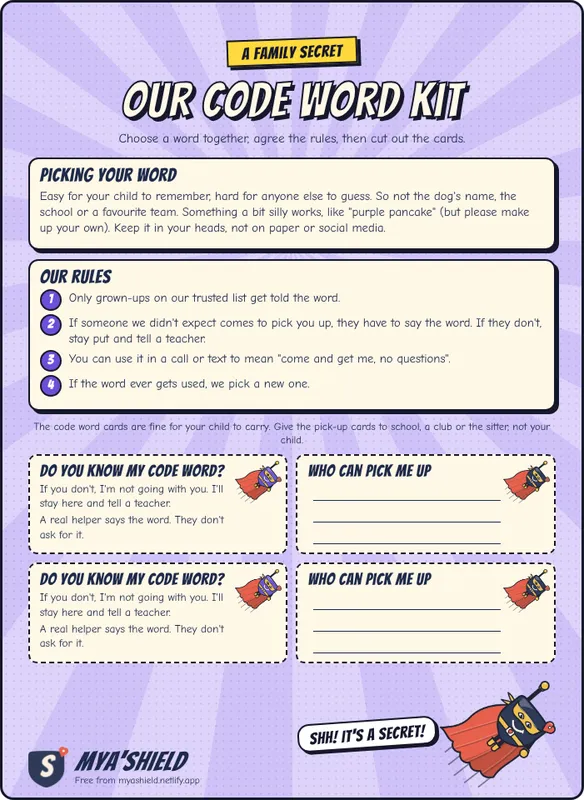
Our code word kit
How to pick your family code word, the rules to agree, and reminder cards your child can carry that never show the word.
We're building Mya'Shield, an early alert device that lets parents know when something seems off.