 Mya'Shield
Get Early Access
Secrets vs surprises: one simple rule for kids
Children love a surprise. A present for Grandma, a birthday party, a cake hidden in the cupboard. But "it's our little secret" is also one of the oldest ways to keep a child quiet about something that's wrong.
Teaching the difference is simple, and it gives your child permission to speak up.
The rule
A surprise is something that will be shared soon, and makes people happy when it is. A secret is something you're told to keep forever, or something that makes you feel worried, sad or scared.
Surprises are fine. Secrets that upset you, you always tell.
What the NSPCC says
This is the "T" in the NSPCC's PANTS rule: talk about secrets that upset you. The charity warns that phrases like "it's our little secret" are used to make children feel worried or scared to tell. It also stresses that sharing a worrying secret shouldn't get them into trouble, even if someone has told them it will.
Who they can tell
Help your child name a few trusted adults: people they could go to if they couldn't come to you. It doesn't have to be family. A teacher, a friend's parent or a sports coach can all count. Some families trace round a hand and write one trusted grown-up on each finger.
Practise with everyday examples
- "We're not telling Dad about his birthday present." That's a surprise. He'll know on Saturday.
- "Don't tell your mum you came in my car." That's a secret. Always tell.
- "This is just between us, nobody else would understand." That's a secret. Always tell.
If your child tells you something
Stay calm, listen, and thank them for telling you. Don't promise to keep it to yourself. If you're worried, get advice: in the UK the NSPCC helpline is 0808 800 5000, and in the US the Childhelp National Child Abuse Hotline is 1-800-422-4453. If a child is in immediate danger, call 999 in the UK or 911 in the US.
Free shareable
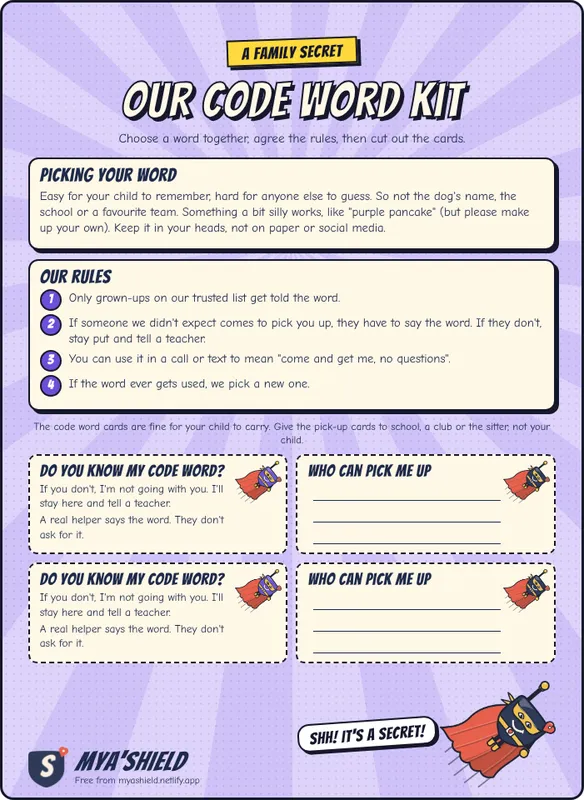
Our code word kit
How to pick your family code word, the rules to agree, and reminder cards your child can carry that never show the word.
We're building Mya'Shield, an early alert device that lets parents know when something seems off. Open, everyday conversations like this one come first.